Does a basement count as square footage?
Published September 11, 2026
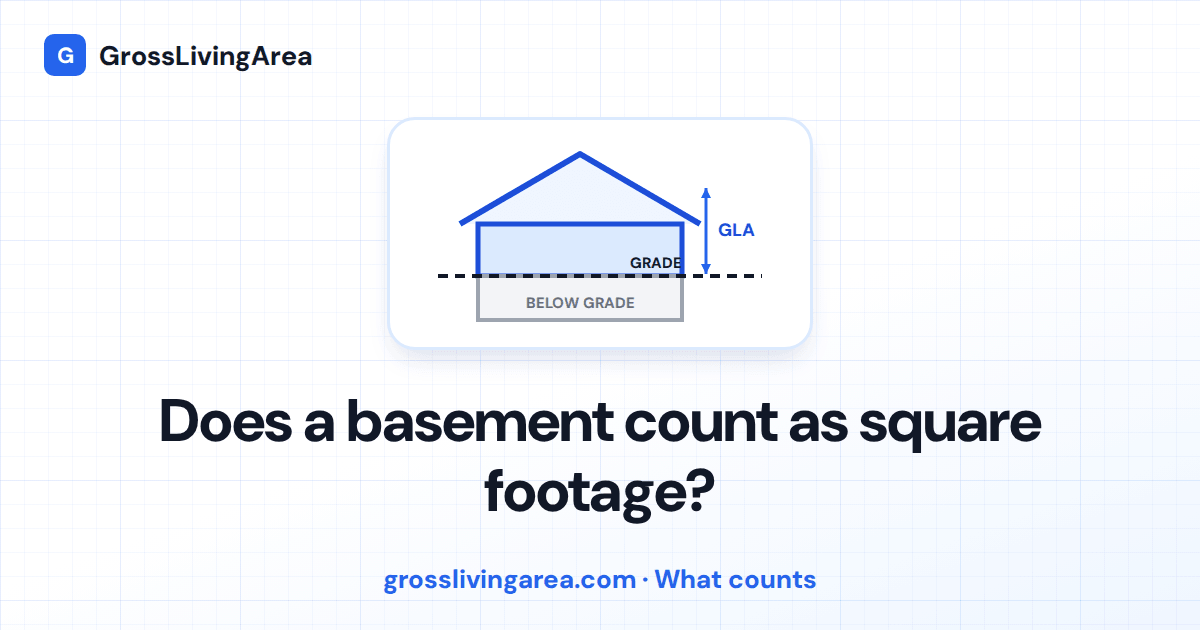
The rule that keeps every basement out of GLA
Gross living area is finished, above-grade space. ANSI Z765 decides "above grade" with one test: is any part of the level below the ground on any side? If so, the whole level is below grade. That single test covers the standard basement, the walkout basement with a door at the back, and the daylight basement with full windows. Fannie Mae requires appraisers to follow the standard, so the answer is the same in every state.
The appraiser still measures the basement. It is reported on the basement line of the report as total area and finished area, and it is valued with its own adjustment. Every other space in the house is ruled on in the what counts guide.
Finished, unfinished, or somewhere in between
- Finished: finished walls, floor, and ceiling, heated, usable year-round. Reported as below-grade finished area. See does a finished basement count.
- Unfinished: bare concrete and open joists. Measured, noted as unfinished, not living area. See does an unfinished basement count.
- Partially finished: only the finished rooms go on the finished line. See does a partially finished basement count.
How many homes have a basement
Across the country, 43% of single-family homes sit over a basement, and 59% of those basements are finished, according to the 2024 Residential Energy Consumption Survey. The share swings from over 80% in some states to under 3% in others.
The number that explains most square footage arguments: 40% of owners with a basement include it when they report their home's size. Under ANSI Z765 none of them should. The same figures for every state are on the state pages, linked from the home page.
Calculator: what a basement adds
Enter the basement area and the above-grade area. The first figure is the gross living area an appraiser reports. The last is the inflated number a listing shows when it adds the basement in.
The basement does not count. The appraisal GLA stays at 1,800 square feet. A listing that adds it in would show 2,600, which overstates the house by 44%.
Fewer new homes get a basement every decade
In 1971, 36% of new single-family houses in the United States were built with a full or partial basement. In 2025 it was 16%. Slab and crawl-space construction took over as building shifted south and west, which is why the basement question is a Northeast and Midwest question more than a national one.
Frequently asked questions
Does square footage include the basement?
Not the square footage an appraiser reports as gross living area. Listings and tax records often add a finished basement into a total, which is why two sources can show different numbers for the same house.
When can you count basement square footage?
Only when the level has no part below ground on any side. At that point it is not a basement under ANSI Z765; it is a ground floor. Any level that is below ground anywhere is below-grade area.
Does a basement count as livable square footage?
A finished basement is livable in the everyday sense and is reported as finished below-grade area. It is not included in gross living area, which is the figure appraisers and lenders compare houses on.