ANSI Z765-2021 Explained: Every Rule in Plain English
Published August 27, 2026
ANSI Z765-2021 is the national standard for measuring the square footage of a house. It tells you where to put the measuring tape (the outside of the walls), what counts as finished living area, and how to report the number. Since April 2022, Fannie Mae has required appraisers to use it on most single-family appraisals.
This guide walks through every rule in the standard in plain English. The standard itself is a short copyrighted document published by Home Innovation Research Labs. We explain it here. We do not reproduce it. Each rule links to a deeper page with the edge cases.
What ANSI Z765 is and who wrote it
ANSI Z765 is the American National Standard for Single-Family Residential Buildings: Square Footage, Method for Calculating. The American National Standards Institute accredits it; Home Innovation Research Labs (the research arm of the National Association of Home Builders) maintains it.
The first edition came out in 1996. It was revised in 2003, 2013, and 2021. The 2021 edition is the current one, and it is the one Fannie Mae names in its Selling Guide. If you see "ANSI Z765-2022" or "2023" anywhere, that is a typo or a guess; see is there a newer version of ANSI Z765?.
One point people miss: ANSI Z765 is a measuring standard, not a valuation or building-code standard. It says how to arrive at a square footage number. It says nothing about whether a bedroom is legal, what a basement is worth, or whether a room meets code.
Who requires ANSI Z765
Fannie Mae requires ANSI Z765-2021 for appraisals on loans with application dates on or after April 1, 2022. The requirement lives in Selling Guide B4-1.3-05 and covers most single-unit appraisal forms, including condos and manufactured homes. Two-to-four-unit properties are outside it.
Freddie Mac accepts ANSI-measured appraisals but did not issue a matching mandate. FHA has never required ANSI; HUD Handbook 4000.1 has its own definitions, and an appraiser can use ANSI methods as long as the FHA rules are still met. VA and USDA likewise have no ANSI mandate.
When a house cannot be measured to the standard (an appraiser is denied access, or the property has a layout the standard cannot handle), Fannie Mae lets the appraiser report that and explain why instead of forcing a bad number.
Rule 1: measure the outside of the house
Square footage under ANSI is measured along the exterior finished surface of the outside walls. Wall thickness is included in the number. That is why an ANSI figure is larger than the sum of the rooms you would get from measuring inside each room.
Floors you cannot reach from outside (a second story) are measured from inside, and the wall thickness is added back. For attached homes, the standard gives separate guidance for shared walls. Details: why wall thickness is included.
Rule 2: only finished area counts
Finished area is an enclosed space suitable for year-round use, with walls, floor, and ceiling finished to a standard similar to the rest of the house. A garage is never a finished area, no matter how nice it is. An unheated sunroom is not. A basement rec room with drywall, flooring, and a finished ceiling is a finished area (but see the next rule).
Finish is judged against the rest of the house. Every finished room needs finished walls, floor, and ceiling and has to be usable all year, whether the house is a basic ranch or a custom build.
The whole What counts as square footage? guide is built on this rule, one space at a time.
Rule 3: above grade vs. below grade
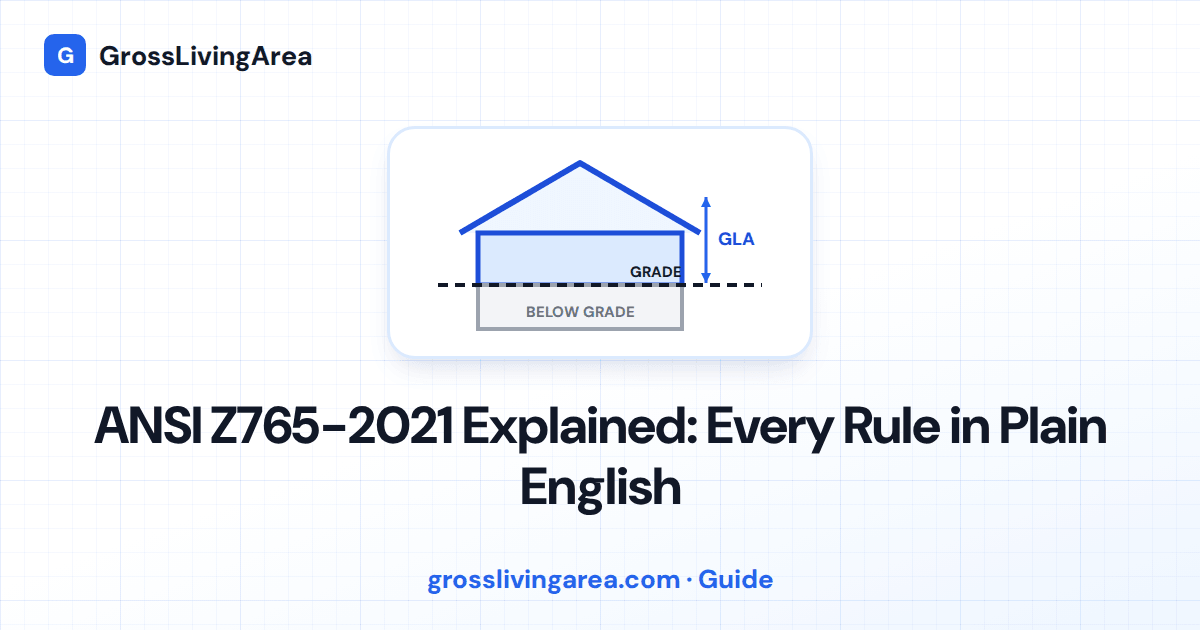
Finished area is reported in two separate numbers: above grade and below grade. Only above-grade finished area is considered gross living area (GLA). Below-grade finished area is reported on its own line and never added to the GLA.
The test is strict. If any part of a level is below the ground on any side, the entire level is below grade. There is no minimum. Even a floor that sits 1 inch below the finished ground on one side is considered entirely below grade. A walkout basement with a full glass wall on the back is still below grade because the front is buried. Full explanation and the exceptions: above grade vs. below grade, the all-sides rule.
Rule 4: ceiling height
Finished area needs a ceiling of at least 7 feet. Under beams, ducts, and similar obstructions, 6 feet 4 inches is allowed. Under a sloped ceiling, at least half of the finished floor area must have a 7-foot ceiling, and only the part with a ceiling of 5 feet or more is counted at all.
This is the rule that decides most attic and Cape Cod second-floor questions. Numbers, diagrams, and the math: ANSI ceiling height requirements.
Rule 5: stairs and openings
Stair treads and landings count as finished area on the floor they descend from. The hole in the floor above a staircase is not double-counted. Other openings to the floor below (a two-story foyer or open-to-below loft) are not counted on the upper level.
The stairs page works through the tread-and-landing math, and the lofts and open-to-below entries in the What counts guide show how the rule plays out in real floor plans.
Rule 6: the finished-connection rule
A finished space only counts if you can reach it from the main living area of the house through other finished space. A finished attic you can only get to by a pull-down ladder does not count. A finished room over a detached garage, reached by an exterior stair, does not count. A finished bonus room you can only access through the garage does not count.
This is the rule behind most surprises people get on their appraisals. Details: the finished-connection rule.
Rule 7: detached structures are reported separately
ANSI measures the house. A detached garage, guest house, pool house, or ADU is measured and reported on its own. Its finished area is never included in the main house GLA, which is the answer to most ADU and guest house questions in the What counts guide.
Attached space is different. A wing or suite that shares a wall with the house and connects through finished space is measured as part of the house and follows every other rule here.
Rule 8: precision and rounding
Measurements are taken to the nearest inch (or tenth of a foot), and the finished area is reported to the nearest whole square foot. Two appraisers measuring the same house should land within a few square feet of each other. Details: ANSI rounding and reporting precision.
How to measure a house to ANSI Z765, step by step
The rules work in a fixed order. This is the sequence an appraiser follows on a typical single-family house.
- Walk the outside and measure each exterior wall to its finished surface, to the nearest inch or tenth of a foot.
- Sketch the footprint of each level and calculate its area from the exterior dimensions. Upper floors are measured inside, with the wall thickness added back.
- Check the ground against every side of each level. A level with any part below grade on any side goes in the below-grade column.
- Check ceiling heights. Leave out finished area under 7 feet, allow 6 feet 4 inches under beams and ducts, and run the sloped ceiling math on rooms under the roof.
- Take out anything that is not finished area: the garage, unfinished rooms, and openings to the floor below, including the opening above the stairs.
- Confirm that every finished space is reached through other finished space. Rooms that fail the finished-connection rule come out.
- Total the above-grade and below-grade finished area separately, then round each total to the nearest whole square foot under the precision rule.
- Report both numbers and state that the house was measured to ANSI Z765-2021.
Detached structures go through the same steps on their own sketch and their own line. None of their area is added to the main house.
How ANSI shows up on an appraisal report
On a Fannie Mae appraisal, the ANSI result lands in the improvements section. Above-grade finished area is the gross living area figure, and the room count next to it covers above-grade rooms only. Below-grade finished and unfinished area go on the basement line.
The appraiser also confirms that the standard was used, or explains why it could not be. That line is the ANSI compliance statement, and reviewers check it against the sketch and the reported square footage.
Read the sketch. It shows the exterior dimensions of each level and the areas left out, so a buyer, agent, or reviewer can redo the math. When a number on the report looks wrong, the sketch is where to start.
ANSI square footage vs. listing and tax record numbers
The ANSI figure is often smaller than the number on a listing, and three habits explain most of the gap. Listings and tax records sometimes fold a finished basement into one total. Some assessors record total building area with the garage included. And some MLS systems use "heated square feet," which picks up heated space that is not finished.
Measuring each room from inside and adding up the rooms misses in the other direction. That sum leaves out walls, closets, and halls, so it comes in under the ANSI number.
When two numbers disagree, ask how each one was produced. The ANSI number is the one measured to a published standard, and it is the one a Fannie Mae appraisal uses. Space-by-space answers for basements, garages, porches, and additions are in What counts as square footage?
Common mistakes when applying the standard
- Calling a walkout or daylight lower level above grade because one side is open. One buried side puts the whole level below grade.
- Counting all of a sloped attic room. Only the part with 5 feet of headroom counts, and only when half the room reaches 7 feet.
- Counting a finished room reached by a pull-down ladder, an exterior stair, or a door from the garage.
- Counting the stairwell on both floors. Stairs count once, on the floor they descend from.
- Adding a detached guest house or ADU into the main house total.
- Measuring inside the walls and calling the result ANSI square footage.
What ANSI Z765 does not cover
The standard was written for detached and attached single-family houses. It says nothing about bedroom counts, egress, permits, or value. Condos and apartments are a gray area the standard only partly addresses; Fannie Mae fills the gap with its own guidance. See what ANSI Z765 does not apply to and ANSI bedroom requirements (there are none).
How to get the standard
The 2021 edition is sold by Home Innovation Research Labs as a PDF. Fannie Mae also publishes free guidance and FAQs that cover what most people need. See where to get the ANSI Z765-2021 PDF. Please do not download bootleg copies. The standard is copyrighted, and the official one is inexpensive.
Every ANSI Z765 rule
- What are the ANSI ceiling height requirements for square footage?
- What is the difference between above grade and below grade?
- Why does ANSI measure square footage from the outside of the walls?
- Do stairs count as square footage?
- What is the finished-connection rule in ANSI Z765?
- How precise does an ANSI Z765 measurement have to be?
- What does ANSI Z765 not apply to?
- Is there a newer version of ANSI Z765 than 2021?
- Where can I get the ANSI Z765-2021 PDF?
- What is the ANSI compliance statement on an appraisal?
- What are the ANSI bedroom requirements?
Frequently asked questions
Is ANSI Z765-2021 mandatory?
For Fannie Mae loans, yes, on most single-unit appraisals with application dates on or after April 1, 2022. FHA, VA, and USDA do not mandate it. Outside lending, nobody is required to use it, but it is the only national standard, so it is what listing disputes and lawsuits fall back on.
Does ANSI Z765 include basements in square footage?
Finished basement area is measured and reported, but as below-grade finished area, not as gross living area. Under ANSI, a level with any part below ground on any side is below grade for its whole area.
What is the minimum ceiling height under ANSI Z765?
7 feet for finished area, with 6 feet 4 inches allowed under beams and ducts. Under sloped ceilings, at least half the area must reach 7 feet, and only area with 5 feet or more of headroom is counted.
Does ANSI Z765 measure from the inside or outside of the walls?
Outside. Square footage is taken along the exterior finished surface of the walls, so wall thickness is included in the number.
Does ANSI Z765 apply to condos?
Only partly. A condo unit has no exterior wall to measure around, so Fannie Mae has appraisers measure the interior perimeter and apply the rest of the ANSI rules.
Is the ANSI Z765 standard free?
No. Home Innovation Research Labs sells the 2021 edition as a PDF. Fannie Mae publishes free guidance and an FAQ that cover what most homeowners and agents need.