What is the difference between above grade and below grade?
Published August 27, 2026
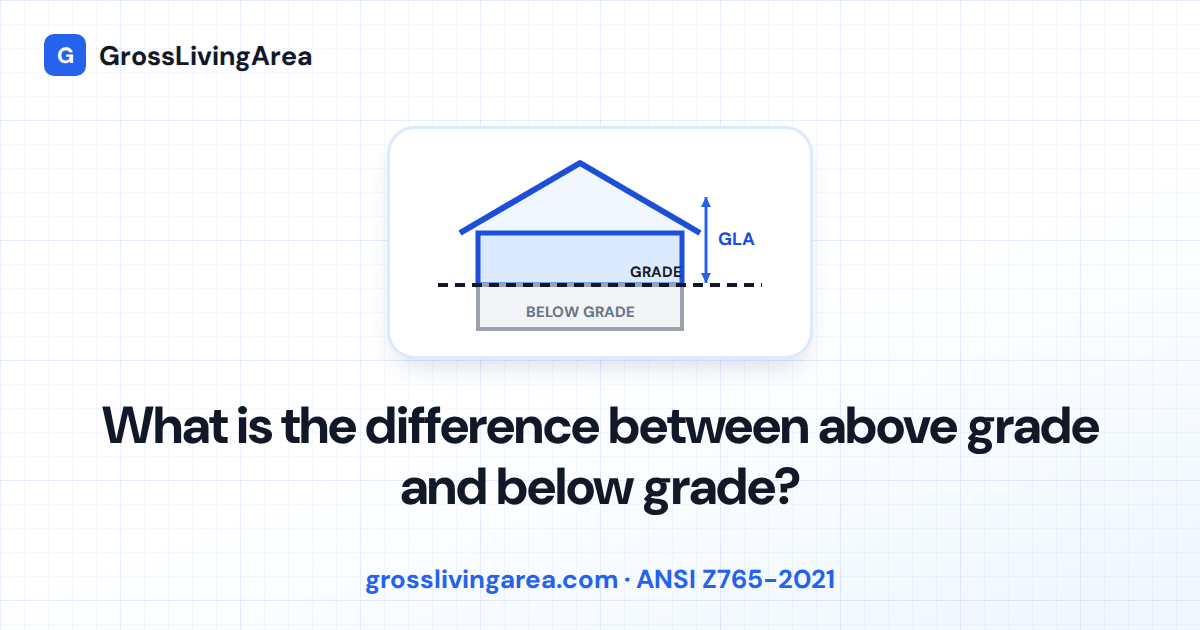
The all-sides rule
ANSI does not average or apportion, and there is no threshold. If any part of the floor is even 1 inch below the finished ground on any side, the entire level is below grade. If the front of a level is buried and the back is fully exposed, the entire level is below grade. This is why a walkout basement is still a basement and why a split-level home can have a "lower level" that is below grade even though it has full-size windows.
"Grade" means the finished ground surface next to the house. Window wells and a small area dug out for a door do not change the grade; they are exceptions to it.
Why it matters
Appraisal forms report above-grade rooms and square footage in the GLA line and below-grade finished area in the basement line. Comparable sales are matched on GLA, so a 1,500 sq ft above-grade house with a 1,500 sq ft finished basement is compared to other 1,500 sq ft houses, not 3,000 sq ft ones. The basement still adds value, just on its own line.
Grade decides which line the area goes on. How much area there is comes from exterior measurement and the ceiling height rule.
Above grade and below grade in construction
Builders use the same words for structure, not living area: below-grade walls are foundation walls in contact with soil, and above-grade walls are framed walls. The appraisal meaning and the construction meaning line up most of the time, which is why the terms are shared.
When the market calls a basement a lower level
In hilly areas, the typical house has a lower level that is below grade at the front and at grade at the rear, opening onto the yard with full windows and a door. Market participants in those areas usually call that space a lower level, not a basement, and pay about the same per square foot for it as for the floors above. Under ANSI it is still below grade, because the front is buried, and the appraiser reports it on the below-grade line. But the adjustment is a market question, not a measuring question: where paired sales show that finished lower-level area is worth as much as above-grade area, the appraiser adjusts it at that rate. The classification decides which line the square footage goes on. The market decides what it is worth.
Fannie Mae below grade guidelines
Fannie Mae adopts the ANSI test and adds a reporting rule: the appraiser must use the same above/below split for the subject and every comparable, and must not fold below-grade area into GLA even if local MLS practice does. Where a market treats a lower level as living area (some split-levels, hillside homes), the appraiser explains and adjusts, but still reports it below grade.
Frequently asked questions
Is a walkout basement above grade?
No. Under the ANSI all-sides rule, a level with any part below ground on any side is below grade. A walkout basement is buried on at least one side, so it is below grade even with a full wall of windows and a door at ground level on the back.
Does below grade square footage count toward the square footage of a house?
It is measured and reported, but not as gross living area. It appears on its own below-grade line on the appraisal and is valued separately.